I’ve sat on both sides of the table for paid media roles. I’ve hired buyers and planners at an agency, and I’ve been the one answering the questions. Good interviews are rare. Most of them test whether the candidate can describe campaign types and recite platform features, which any certification course teaches in a week and which tells you nothing about whether they’ll make the account more profitable. Here’s what I’d ask instead, and what the answers reveal.
Start with measurement, not campaigns
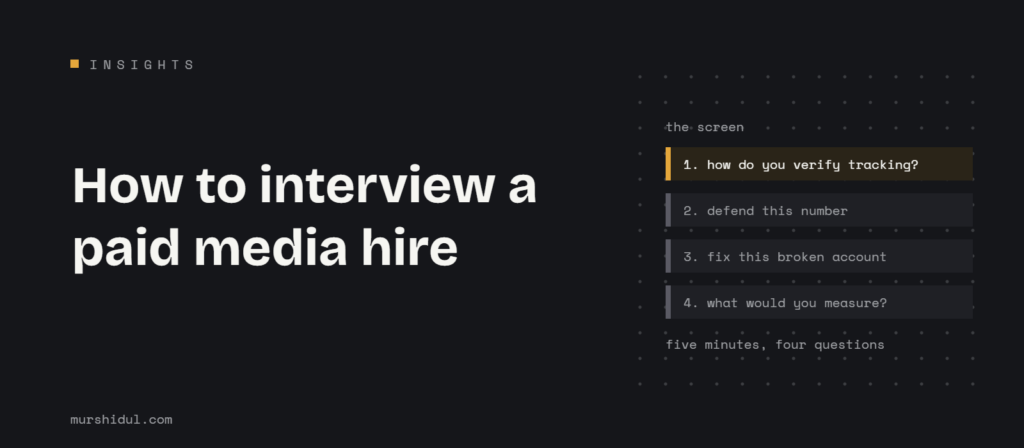
“Walk me through how you’d verify that an account’s conversion tracking is correct before you change anything.” A strong candidate talks about reconciling platform conversions against real orders or CRM leads, checking for duplicate events, and looking at consent. A weak one says they’d check that the pixel is installed. The gap between those two answers is the gap between someone who will optimize toward real revenue and someone who will optimize toward whatever the dashboard says. I’ve written about why this comes first; in an interview it’s the single most predictive question.
Ask for a number they’re proud of, then ask how they know it’s true
Every candidate has a “reduced CPA by 40%” story. The follow-up is where the signal is. Ask 40% against what baseline, measured how, over what period, and what else changed at the same time? Someone who has actually done the work will tell you the caveats unprompted. Maybe the baseline was inflated by broken tracking, or a product launch helped, or they’re not sure how much was the campaign change versus seasonality. Someone who hasn’t will defend the number. You want the person who is uncomfortable with a clean story, because real accounts never produce one.
Give them a bad account, not a good brief
Take-home tests that ask for a campaign plan reward people who are good at writing campaign plans. Instead, give a redacted screenshot of a real account with a problem in it, such as a Performance Max campaign eating brand search, a conversion action that’s clearly a page view, or a Meta account with ten ad sets in learning. Ask what they’d do in the first week. The best answers prioritize ruthlessly, say what they’d leave alone, and ask what the business margin is before proposing any budget change. ROAS is a ratio, not a goal is the thinking you’re testing for.
Test for how they handle automation
“Where do you still add value now that bidding and targeting are automated?” Weak answers resist the automation or claim to beat it with manual bids. Strong answers accept it and point at what’s left, which is creative volume and angles, measurement integrity, structure that keeps the automation honest, and the business conversation about what to optimize for. The platforms have taken the mechanical work; you’re hiring for judgment, and this question shows whether the candidate knows that.
What recruiters can screen for in five minutes
You don’t need to understand paid media to run the first filter. Ask three things. Has the candidate run a budget large enough that mistakes cost real money, and can they say what the largest monthly spend they personally owned was? Can they name one thing they got wrong on an account and what they changed as a result? And can they explain what they’d measure in their first month without using the words “impressions”, “clicks” or “engagement”? Candidates who pass all three are worth a hiring manager’s hour. Most don’t.
What I’d ignore
Platform certifications on their own. I hold several, and they show someone studied, which says little about whether they can run an account. Agency brand names on their own, since the work at big agencies varies enormously by team. And a portfolio of pretty creative, unless the role is creative. The things that predict performance in this job are whether the person checks their numbers before trusting them, whether they can say what they don’t know, and whether they think about the client’s margin rather than the platform’s metrics. None of those show up on a certificate.
Working through something similar
This essay is one part of the measurement-first method. I’m always glad to compare notes on measurement and paid media. Get in touch → or find me on LinkedIn.