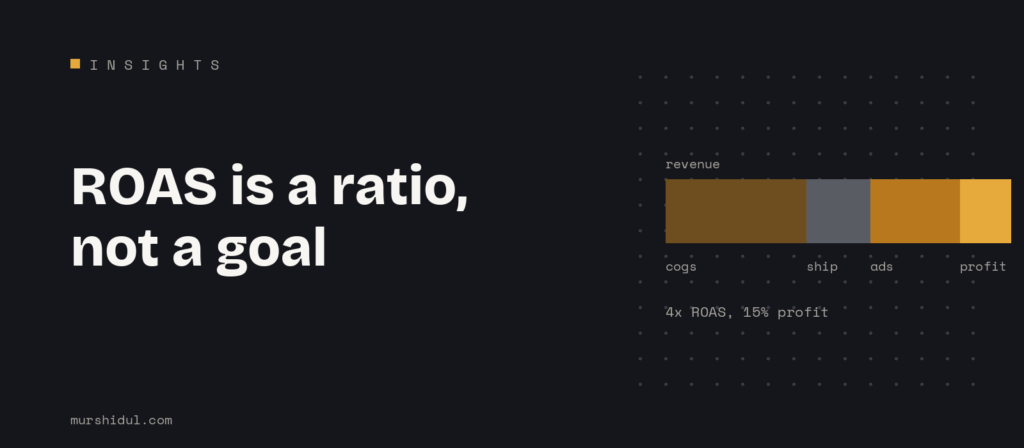
Ask a founder what their paid media target is and the answer is usually a ROAS. Four, five, whatever the agency said was good. The number has become a goal in itself, and that’s a problem, because ROAS is a ratio and ratios don’t pay salaries. A campaign at 8x ROAS on $500 a day makes less money than one at 3x on $10,000 a day, and the second one might still be losing money depending on what’s left after you ship the product.
What ROAS leaves out
Revenue divided by ad spend ignores cost of goods, shipping, payment fees, returns and discounts. A 4x ROAS on a product with 25% gross margin is break-even before you’ve paid anyone. The same 4x on a 70% margin product is a healthy business. The ratio is identical; the outcomes are opposite. Any target set without the margin in the equation is a target set on the wrong number.
Returns alone are big enough to change the answer. The National Retail Federation and Happy Returns estimated that US shoppers would send back 15.8 percent of everything they bought in 2025, and 19.3 percent of what they bought online. A ROAS calculated on order value counts every one of those returned orders as revenue.
It also ignores scale. ROAS almost always falls as spend rises, because you exhaust the cheapest audiences first. A team told to hold 5x will cut budget every time it dips to 4.5x, and will never find out that 4x at triple the spend was the most profitable the account could be. I’ve written about how to spend the first $10K a month; the harder question is how to know when to spend the second.
The numbers I use instead
Contribution margin per order after ad cost. Revenue minus cost of goods, fulfilment and fees, minus the ad spend it took to get the order. If that’s positive, the order made money. If it’s negative, no ROAS makes it a good order. This is the one number every campaign should be judged on, and most accounts can’t produce it because the margin data lives in a spreadsheet the marketing team has never seen.
Marketing efficiency ratio. Total revenue over total marketing spend, across all channels, for the month. It’s blunt, but it’s immune to the attribution games platforms play with each other. When Meta and Google both claim the same sale, MER doesn’t care.
New-customer cost against payback. What it costs to acquire a first-time buyer, and how many months of their purchasing it takes to earn that back. A high CAC with a three-month payback is fine. A low CAC with no second purchase is a leak.
Why the platforms push ROAS
Because it’s the number they can report. Google and Meta see the sale value you send them and the spend they charged you; they don’t see your margins. Target ROAS bidding is built on that limitation. You can get partway around it by sending profit instead of revenue as the conversion value, which turns target ROAS into a crude target margin. Few accounts do it, because it means someone has to connect the product catalogue to the tracking, and that’s measurement work nobody budgets for.
I still look at ROAS every day. I just don’t treat it as the goal. The goal is profit at the largest scale the margins support. ROAS is one input to finding that, and on its own it will steer you toward a small, efficient-looking account that leaves money on the table every month.
Working through something similar
This essay is one part of the measurement-first method. I’m always glad to compare notes on measurement and paid media. Get in touch → or find me on LinkedIn.