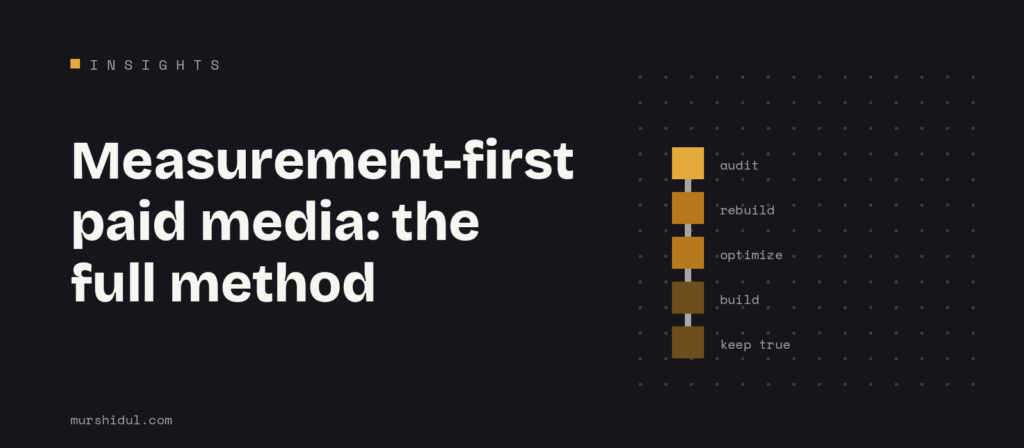
Most paid media advice is about campaigns: structure, bidding, creative, audiences. All of that matters, and all of it sits on top of one thing nobody talks about at the pitch stage, which is whether the numbers coming back from the platforms are true. In 14 years of running media for agencies, e-commerce companies and a telecom, the largest improvements I’ve been part of came from fixing measurement first and only then touching spend. This is the method, in the order I apply it, with links to the detail where I’ve written it up.
Why measurement comes first
Every automated system in modern advertising learns from conversion data. Smart bidding in Google Ads, Advantage+ in Meta, lookalike audiences, value-based bidding, the ROAS column on the dashboard. If the conversion data is wrong, each of those systems is wrong in the same direction, and none of them will tell you. Campaigns keep running and reports keep filling. The error only shows when someone lines up platform-reported sales against the orders the business actually recorded.
At ShareTrip, that comparison showed our conversion tracking was double-counting bookings. Every channel looked better than it was. Rebuilding the tracking and cleaning up attribution cut acquisition cost by about 25% before a single campaign changed, and no campaign change that year came close. That experience is the reason the sequence below starts where it does.
Step 1: audit what the platforms are counting
Before changing anything, find out what’s being reported and how far it is from reality. The method is in The tracking audit nobody budgets for: reconcile platform conversions against the source of truth, check for duplicate events, review every conversion definition, measure consent loss, and walk the checkout or form path with a debugger open. The output is a gap, and a list of why the gap exists.
The most common findings, in rough order: purchase events firing twice, a conversion action nobody remembers adding that smart bidding has been chasing for months, a payment gateway that breaks the session, and consent mode in its basic setting dropping every declined visitor. Consent mode v2 is not a checkbox (coming soon) covers that last one, which almost nobody knows they have.
Step 2: rebuild the foundation
Attribution problems are rarely a bug. They’re a foundation that was never laid properly, and patching the symptom brings the problem back in a different form. Attribution doesn’t break by accident sets out the three-step rebuild: define what a conversion is in business terms, implement it once in a single tracking layer, and only then connect the platforms to it.
In 2026 that single layer is server-side. Browser pixels now miss a real share of conversions to iOS, ad blockers and declined consent. Server-side tracking is now the price of admission explains the order of operations: consent framework, then server container and GA4, then Meta’s Conversions API with deduplication, and only then let automated bidding lean on the improved signal.
Step 3: optimize on honest numbers
With the data fixed, the campaign work starts to mean something. Two things change immediately.
First, the metrics. A dashboard full of impressions, clicks and platform-reported ROAS can hide an account losing money on every customer; Vanity metrics are a tax on bad decisions explains which numbers to replace them with. And ROAS itself, the number most founders set as a target, is a ratio that ignores margin and scale. ROAS is a ratio, not a goal (coming soon) sets out the three numbers I plan budgets on instead: contribution margin per order after ad cost, marketing efficiency ratio, and new-customer cost against payback.
Second, the campaigns. Automated campaign types report their own success, and without a fence they take credit for sales that were already going to happen. Performance Max needs a fence (coming soon) covers brand and customer exclusions and the two-week test that shows what the campaign is really adding. In B2B, the same discipline means refusing to optimize to the form fill; Stop optimizing to the form fill shows how offline conversion imports get the platforms optimizing toward leads that close.
Step 4: build the channel
Once measurement and optimization are sound, the account can take on real growth work. Where that growth comes from has shifted. Targeting, the skill that used to separate good buyers from average ones, has been automated by the platforms; what’s left in human hands is the ad. Creative is the new targeting (coming soon) explains why creative volume now matters more than audience architecture, and why measurement still decides which creative wins.
For a founder spending their first serious budget, concentration beats diversification. The first $10K/month, spent properly gives the 70/20/10 split and when to change it. For Canadian B2B companies, Running B2B lead gen in a privacy-first era starts from CASL and honest tracking rather than volume.
And some channels are new enough that there’s an edge in building them early. At Daraz (Alibaba Group) I built live commerce into a measurable acquisition channel with a 700-creator network, growing livestream-driven orders 139%; Live commerce is coming to Western markets is what I’d tell a Western brand about the format now.
Step 5: keep it true
Measurement decays. Developers rename events, someone adds a test conversion, a new banner changes consent rates, and a quarter later the account is optimizing on something slightly wrong again. The fix is a schedule: a quarterly tracking check, a seasonal check before any big sale (What 11.11 taught me about Black Friday budgets (coming soon) covers why the sale-day version matters most), and a full pass each December. The year-end audit your ad account needs (coming soon) is that December pass, ending with the one page to write before January’s budget conversation.
The short version
Fix the measurement before you touch spend. Rebuild it once, server-side, with consent handled properly. Replace vanity metrics and bare ROAS with margin-aware numbers. Fence the automated campaigns so they report what they add. Put the saved budget into creative and into the channels where an edge still exists. Then check the whole thing on a schedule, because it will drift.
None of this is glamorous, and almost none of it shows up in a creative review. It’s the work that makes everything else in the account true, and in my experience it’s where the biggest returns have always been. The case studies at ShareTrip, Daraz and Banglalink show what it looked like on real accounts.
Working through something similar
I’m always glad to compare notes on measurement and paid media. Get in touch → or find me on LinkedIn.