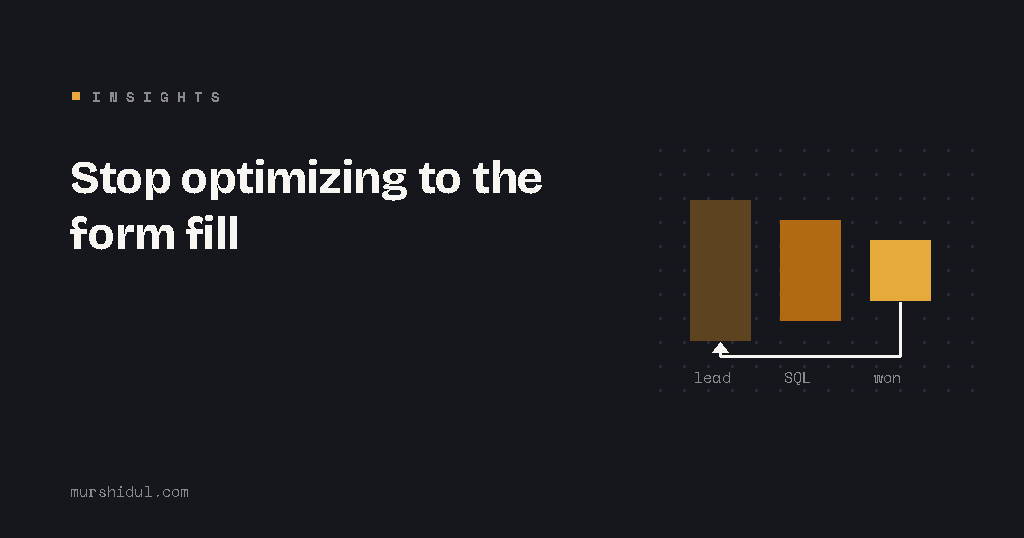
Ad platforms are very good at finding more of whatever you tell them a conversion is. In B2B lead generation, most accounts tell them a conversion is a form fill. That instruction is the most expensive mistake I see.
The form fill is the wrong finish line
A form fill is easy to count and arrives fast, which is why it becomes the default. But the platform has no idea which of those forms came from a buyer and which came from a student, a competitor, or someone who misread the ad. It treats them all as wins. Over a few weeks, smart bidding learns that the cheapest form fills come from the broadest, least qualified audiences, and it starts buying more of them. Cost per lead drops. Sales starts complaining about lead quality. Both things are true at the same time, and the dashboard only shows the first one.
Feed the outcome back
The fix is to tell the platforms what happened after the form. Google Ads can import offline conversions matched on the click ID, or on hashed contact details with enhanced conversions for leads. Meta’s Conversions API can take lead-stage events from a CRM. Either way, the idea is the same. When a lead becomes qualified, books a meeting or closes, that event goes back to the platform tied to the original click.
Once that loop exists, you can move the optimization target down the funnel. Bid toward qualified leads instead of raw leads. Use the form fill as a secondary signal so the platform still has enough volume to learn, but stop treating it as the goal.
What it takes in practice
Capture the identifiers. The click ID or the contact details need to land in the CRM with the lead record. If the form doesn’t pass them through, nothing downstream can work.
Agree on what “qualified” means. This is a conversation with sales, not a setting. If marketing and sales define it differently, the imported data will be noisy and the bidding will follow the noise.
Keep enough volume. If you only import closed deals and there are five a month, the platform can’t learn from that. Pick the deepest stage that still gives you a steady flow of events, and move deeper as volume allows.
Respect consent. In Canada that means CASL-compliant consent at the form and only sending back data you’re allowed to use. Matching on hashed details doesn’t remove that obligation.
What changes
Cost per lead usually goes up. That’s the part clients need to hear early, because it looks like a step backwards. What should come down is cost per qualified lead and cost per customer, which are the numbers that pay for the campaign. I’d rather report a higher CPL with a pipeline sales actually wants than a cheap CPL nobody can close.
It also changes the reporting conversation. Instead of defending lead volume, you’re talking about pipeline, which is the conversation the client wanted to have in the first place.
Working through something similar
This essay is one part of the measurement-first method. I’m always glad to compare notes on measurement and paid media. Get in touch → or find me on LinkedIn.