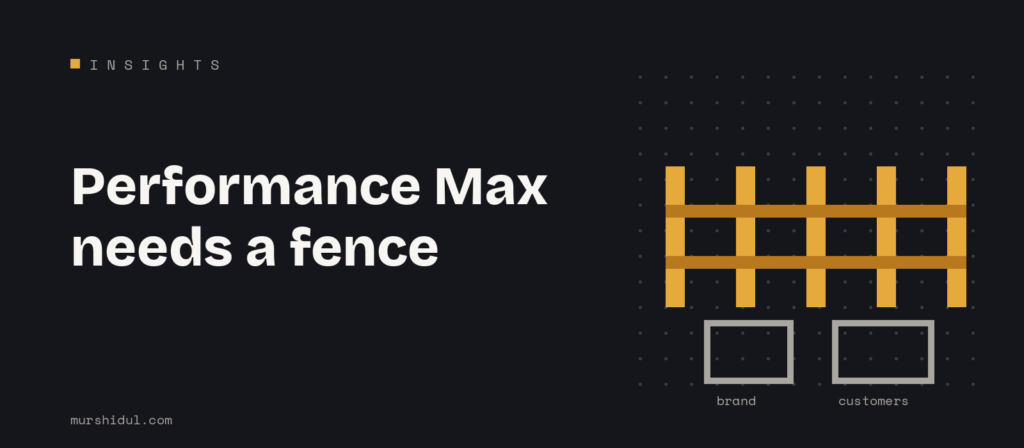
Performance Max is the campaign type Google most wants you to run, and on a lot of accounts it does well. It also has a habit I’ve seen on almost every account that runs it alongside anything else. It takes credit for sales that were already going to happen. Left alone, it finds the people searching your brand name, the people who abandoned a cart yesterday, and the people on your email list, and it reports them as conversions it generated.
How the cannibalization works
PMax bids across Search, Shopping, YouTube, Display, Gmail and Discover from one budget, with one goal. It goes where conversions are cheapest, and the cheapest conversions on any account are the ones closest to the sale. On most accounts I’ve worked on, brand searches convert several times better than generic ones, and retargeting audiences several times better than prospecting. PMax doesn’t know or care that those people were already yours; it sees a conversion at a low cost and bids harder next time.
Your report then shows PMax at a brilliant ROAS, your brand search campaign shrinking, and total revenue flat. The budget moved, the sales didn’t. I wrote about this kind of reporting illusion in Vanity metrics are a tax on bad decisions; PMax is the most sophisticated version of it.
The fence
Brand exclusions. Google added brand exclusion lists to PMax for a reason. Use them. Your brand terms belong in a dedicated search campaign where you control the bid, the copy and the landing page, and where you can see what it’s actually costing.
Audience signals are not targeting. Feeding PMax your customer list as a signal helps it find lookalikes. It also tells it exactly who your existing customers are, and it will happily serve them ads. If retention isn’t the goal, exclude your customer list at the account level or accept that part of PMax’s reported revenue is from people who would have bought anyway.
New-customer goals. The “new customer acquisition” goal setting, with a value adjustment for new versus existing customers, is the closest PMax gets to being honest about incremental revenue. It requires a working customer list upload and conversion tracking that can tell new from returning, which brings us back to measurement.
Separate campaigns for separate jobs. One PMax campaign for everything is one budget chasing the easiest conversion. A prospecting PMax with brand and customers excluded, running next to a brand search campaign and a retargeting campaign, costs more to set up and tells you something true every month.
The test that settles it
Pause PMax for two weeks on a mature account and watch total revenue, not PMax revenue. If revenue drops by roughly what PMax was reporting, it was incremental and you should turn it back on with confidence. If revenue barely moves while brand search and direct traffic rise, you’ve found out what the campaign was really doing. Most accounts land somewhere in between, and that proportion is the number to manage the campaign against.
I’m not against Performance Max. I just want to know what I’m paying for. A campaign that reports its own success, with no fence around it, will always look like your best performer. The question is whether the business is better off, and only the fence lets you answer that.
Working through something similar
This essay is one part of the measurement-first method. I’m always glad to compare notes on measurement and paid media. Get in touch → or find me on LinkedIn.