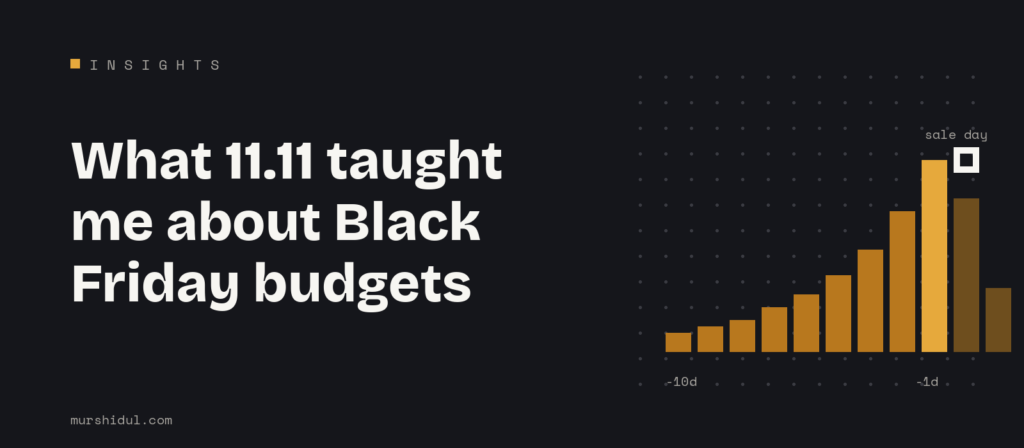
At Daraz, 11.11 was the biggest day of the year, and the days around it were where the budget was won or lost. The patterns I saw there show up every November in Western markets around Black Friday, just with different names on the sale. The mistakes are the same ones.
The days themselves keep getting bigger. Adobe tracked US online spending of $11.8 billion on Black Friday 2025, up 9.1 percent on the year before, and $44.2 billion across the whole stretch from Thanksgiving to Cyber Monday. Black Friday grew faster than Cyber Monday for the second year running. More money chasing the same few days makes the timing of your own spend matter even more.
The money moves before the sale
The instinct is to hold budget for the day itself. The data says most of the cheap intent is captured in the ten days before, when people are building wishlists, comparing prices and adding to cart without buying. Audiences built in that window are the ones that convert on the day at a fraction of the cost of cold traffic. If you start spending on the morning of the sale, you’re bidding against every other brand for the most expensive clicks of the year, with no warm audience to retarget.
What worked was a ramp beginning about two weeks out, weighted toward reach and add-to-cart, with the conversion-optimized budget held for the final 72 hours. Spend on the sale day was never the peak. The peak was the day before.
Smart bidding doesn’t know it’s a holiday
Automated bidding learns from the last few weeks. On a normal week it’s good at that. On a sale day, conversion rates double or triple inside an hour, and the algorithm’s model is wrong for most of the day while it catches up. Two things help. Seasonality adjustments in Google Ads, set a day ahead, tell the system to expect the jump. And loosening target ROAS or CPA for the window stops the system from throttling spend just when the cheap conversions arrive. The teams that left their targets untouched on 11.11 consistently underspent and then complained the platform didn’t deliver.
The pacing problem is a measurement problem
You can’t pace what you can’t see. On a high-volume day, platform reporting lags by hours, and if your conversion tracking has any of the problems I described in The tracking audit nobody budgets for, the lag plus the error means you’re making budget calls on numbers that are both late and wrong. Before every big sale we did a tracking check specifically for the day. We confirmed purchase events fired once and the server feed was healthy, and we set up a back-end sales dashboard we could compare against platform numbers every hour. That dashboard was worth more than any bid strategy.
What to stop doing
Launching new creative on the day. Anything that hasn’t exited learning by then is burning the most expensive impressions of the year to teach the algorithm. Launch two weeks out and let the winners carry the day.
Treating the sale as a separate account. It’s the same customers, the same funnels and the same tracking. Campaign structure can change, measurement shouldn’t.
Judging it on sale-day ROAS alone. Discount days pull demand forward. The real read comes from the four weeks around the event against the same window last year, and from how many first-time buyers came back at full price in the following quarter. At Daraz, that return rate was the number we actually planned next year’s budget on.
If you run a sale this November, the budget curve matters more than the budget total. Spend the money where the intent is cheap, which is almost never the day everyone else is spending it.
Working through something similar
This essay is one part of the measurement-first method. I’m always glad to compare notes on measurement and paid media. Get in touch → or find me on LinkedIn.