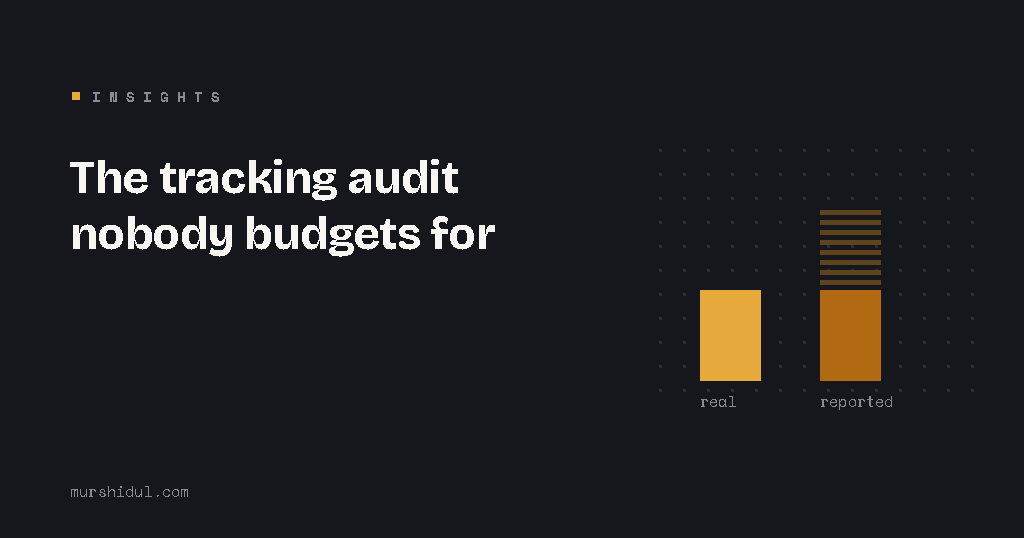
Every media plan I’ve seen has a line for creative, a line for spend, and usually a line for tools. Almost none have a line for checking whether the numbers coming back are true. That gap is where a lot of money quietly disappears.
Broken tracking doesn’t look broken
When a campaign underperforms, someone notices. When tracking breaks, the opposite usually happens: results look better than they are. A purchase event fires twice. A thank-you page gets reloaded and counted again. A payment gateway sends users to another domain and the session restarts as a new visitor. None of these throw an error. The dashboard fills up, ROAS looks healthy, and the bidding algorithms keep learning from data that is wrong in a consistent direction.
At ShareTrip, our conversion tracking was double-counting bookings. Nothing about it looked unusual from the outside. Once we rebuilt the Firebase conversion tracking and cleaned up the attribution, the picture changed, and so did the decisions we made from it. CAC came down about 25%, and no single campaign change in that period came close to that.
What I check every quarter
Conversion counts against the source of truth. Pull orders, bookings or qualified leads from the back end or CRM and line them up against what GA4, Google Ads and Meta report for the same period. They will never match exactly. They should be close, and the gap should be stable. A gap that suddenly widens tells you something changed.
Duplicate events. Check whether purchase or lead events fire more than once per transaction ID. If you run a pixel and a server-side feed together, confirm deduplication is actually working, not just configured.
Conversion definitions. Over time, someone adds a newsletter signup or a page-scroll event as a conversion “just to test it” and forgets to remove it. Smart bidding then optimizes toward it. List every conversion action set as primary and ask whether each one is something the business would pay for.
Consent and loss rates. Look at how much traffic declines tracking and whether that share has moved. A new banner design or a site update can change it overnight.
Cross-domain and checkout paths. Walk through a real purchase or form submission yourself, with the debugger open. Payment providers, booking engines and embedded forms are where sessions break most often.
Why it never gets budgeted
An audit doesn’t produce anything you can put in a creative review. On a good day, its output is “the numbers were right.” On a bad day, it’s “the numbers we’ve been reporting for six months were inflated,” which nobody is eager to hear. So it gets pushed to next quarter.
I’ve come to treat it the other way around. Measurement is the input to every other decision on the account: which campaigns get budget, which audiences get cut, what we tell the client is working. If that input is off, everything built on top of it is off by the same amount. A few hours a quarter is cheap insurance against optimizing confidently in the wrong direction.
Working through something similar
This essay is one part of the measurement-first method. I’m always glad to compare notes on measurement and paid media. Get in touch → or find me on LinkedIn.